In the times when the internet is filled with bogus information on what to eat, what to avoid and what to necessarily include in your diet, the question around cold press and refined remains among the most asked.
What is Cold-Pressed Oil?
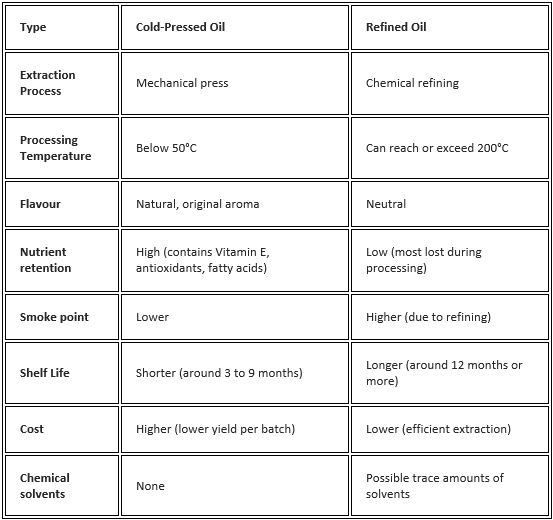
Cold Press oil, as the name suggests, is extracted from seeds using traditional cold press techniques. The process does not involve any external heat, thus is considered to retain the original nutrients and aroma of the seed. In addition, as no bleaching agents or heavy machinery are used, the technology offers benefits such as lower energy consumption and lower investment costs.
Through WeAct, rural women entrepreneurs are building on this traditional knowledge and local resources to bring cold-pressed oils to a wider market.
What is Refined Oil?
Refined oil, on the other hand, originates from the same seeds or sources but undergoes more processing. During refining, the oil is treated to remove impurities, free fatty acids and unpleasant odours, resulting in a clean and clear oil. The process, however, can also lead to the loss of some nutrients and naturally occurring compounds along with the impurities.
Since refining is a more efficient process and results in higher oil yields per batch, refined oils are comparatively cheaper than cold-pressed oils.
What’s the Debate: Cold Press v/s Refined
Before discussing which one of the two is better, let’s dive in and understand the key parameters that differentiate cold pressed oil form the refined.
Is Cold Pressed Oil Suitable for Indian Cooking?
Cold-pressed oil checks many of the boxes for health-conscious consumers, but it is often questioned for high-heat Indian cooking.
Indian cooking conditions subject oil to very high temperatures, including tempering (tadka) and deep frying, during which the oil temperatures can go above 170 °C. Since cold-pressed oils have a low smoke point (the temperature at which oils begin to break down, affecting nutritional quality) they are generally considered unsuitable for deep frying.
However, this is not universal. Since the discussion largely revolves around smoke point, cold press oils with higher smoke points can be safely used on Indian stoves.
In fact, some studies suggest that refined oils, particularly those high in PUFAs, can degrade more easily and therefore should be avoided for frying. Probably the reason why consumers are moving towards cold pressed.
The Growing Interest in Cold-Pressed Oils in India
As we move towards a more machinery-driven world, the idea of going back to the basics is gaining attention in India. A few years ago, refined oil was the default choice for most urban Indian households. Today, a shift is being observed.
“The India’s cold pressed oil market reached ₹755.2 million in 2025 and is projected to reach ₹1,213.8 million by 2034, growing at a CAGR of 5.41% during 2026-2034,” as per a report by imarc.
Platforms like WeAct act as a bridge of this transformation, empowering rural women to revive ancestral extraction methods while meeting the growing demand for authentic, nutrient-rich foods. From coconut and mustard to sesame and groundnut oils, they are responding to the growing interest in healthier and traditionally produced edible oils.
What Is the Better Option for Your Family?
Every seed has its own distinct characteristic, to get the maximum benefits you can opt for a hybrid kitchen strategy by using different oils for different cooking needs.
For Daily Sautéing, Tadka, and Low-to-Medium Heat Cooking: Cold-Pressed Oils (such as Mustard, Groundnut, or Sesame) are the better choice.
For Deep Frying (High-Heat Cooking): Use Cold-Pressed Groundnut or Mustard Oil (which naturally possess higher smoke points around 190°C–230°C).
For Raw Drizzling and Salads: Extra Virgin Olive Oil or Cold-Pressed Coconut Oil offers maximum nutritional benefit when consumed unheated.
By opting for cold-pressed oils by WeAct women, you not only secure pure, cold pressed oils for your family but also directly support their families. It’s a win-win!